
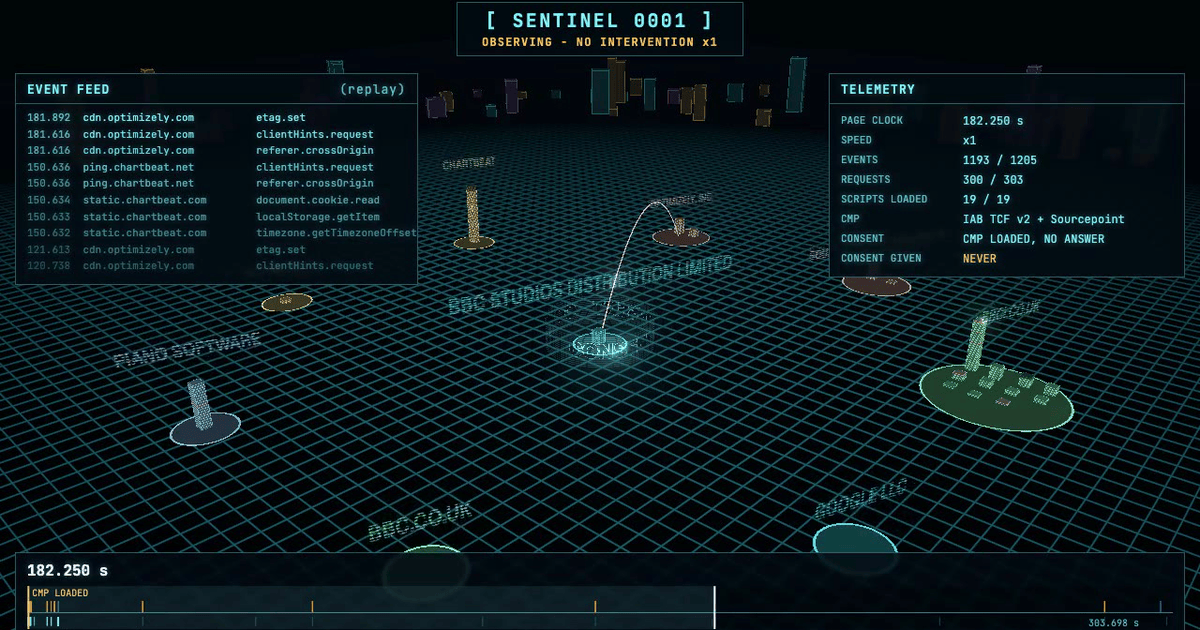
Yesterday I released my research into website surveillance - "We Take Your Privacy Seriously." - which is based on forensic audits of the top 100 English-language content websites in the world. The evidence is damning, showing that all 100 websites unlawfully deployed techniques used to track and profile individuals without the consent required under EU law, to the tune of trillions of privacy invasive events every month across the EU. That evidence will now be sent to those tasked with enforcing the law - the Supervisory Authorities - as formal legal complaints.
What is particularly striking is that while I was preparing to publish, Optimizely was being hacked - and malicious code was served from the websites of some of the biggest brands in the world, including the BBC and CNN. Both of those websites were audited in my research.
What happened on 16th November
Optimizely is an experimentation platform - website owners use it to show different versions of a page to different visitors and measure which one performs better, which in practice means monitoring what people do on the site in order to work out which marketing message works best on them. Each customer loads a JavaScript "snippet" from Optimizely's servers, and that snippet runs inside every page with exactly the same power as the website's own code.
According to the analysis published by Scott Helme at Report URI, on 16th November an attacker wrote their own code into the snippets of Optimizely customers. Report URI found 188 infected snippets belonging to 178 organisations - including Zoom, Salesforce, GitLab, IKEA, HSBC, Equifax, Air France-KLM, Ledger, Fox News, the BBC and CNN. The first injection they saw was in the BBC's snippet at 04:21 UTC, and the attacker's payload was first seen running on bbc.com at 08:28 UTC.
The payload did several things at once. It swapped cryptocurrency wallet addresses shown on a page for the attacker's own, it skimmed payment card details from forms, it stole cookies and took screenshots of the page, and on iPhones and iPads it delivered the Coruna and DarkSword iOS exploit kits. Bitquery has since traced the attacker's wallets and found 19 payments from victims, totalling around $2,260, on 16th November alone. Nobody knows yet how many card numbers were taken, how many cookies and screenshots were stolen or how many iPhones were infected - none of that leaves a trace on a blockchain.
The websites themselves were never breached. Their own code and their own servers were untouched - the malware arrived through a script that each of them had chosen to load from a third party, into every visitor's browser, on every page view.
What my evidence shows
Every website in my research was accessed from my home in Malta, between 1st and 3rd October 2026, in a clean Chrome browser profile with no privacy tools installed. I never answered the consent banner, specifically because I wanted to measure what happens in the absence of consent - so everything recorded happened before any consent was given. Each capture is signed in a hardware Secure Enclave, hash chained, timestamped by an RFC 3161 timestamp authority and recorded on the Bitcoin blockchain, so nobody can claim it was altered after the fact.
When I went back through that evidence yesterday, this is what it showed.
On the BBC home page, the BBC's Optimizely snippet (cdn.optimizely.com/public/4621041136/s/bbcx_prod.js) was inserted into the head of the page 25 milliseconds after the page began loading - it was the 11th script on the page. There was no integrity check on the script tag, which means the browser would run whatever Optimizely's servers handed it. Before any consent was given, that code read and wrote cookies, wrote to the browser's local storage, read the browser's user agent, watched the page for changes and sent events back to Optimizely's servers. The same snippet loaded on the BBC's privacy policy page.
On the CNN home page, CNN's Optimizely snippet (cdn.optimizely.com/public/125375509/s/landingprod.js) loaded and ran in the same way, and on CNN's cookie page the snippet was served from CNN's own domain (edition.cnn.com/optimizelyjs/128727546.js) - again reading and writing cookies before any consent was given.
So as recently as six weeks before the attack, both of these websites were deploying Optimizely to every visitor without the legally required consent. That is the very same channel through which the malware reached people on 16th November.
Consent would have limited the damage
Article 5(3) of the ePrivacy Directive has required consent before anything is stored on or read from a person's device - unless it is strictly necessary to provide the service they asked for - since 2003. A/B testing and marketing optimisation are not strictly necessary for anyone to read the news. Optimizely should only ever have been loaded for those visitors who agreed to it.
Had the BBC and CNN met that legal obligation, this hack would have had far less impact, because the compromised Optimizely library would never have been deployed in the majority of cases. Most people do not consent to tracking and profiling when they are given a genuine choice, and those people would never have received the attacker's code at all - no swapped wallet address, no skimmed card, no exploit kit sent to their phone. Instead, every visitor who loaded those pages while the snippets were infected received it, the moment the page loaded.
Every third-party script a publisher loads without consent is code from someone else's server running with full access to the page their visitors are reading, typing into and paying through - and when that third party is compromised, the number of people harmed depends on how many people the publisher loaded it for.
Liability
Article 82 of the GDPR gives anyone who has suffered material or non-material damage as a result of an infringement the right to receive compensation from the controller or processor, and the Court of Justice has made it clear in Osterreichische Post (C-300/21) that there is no threshold of seriousness for non-material damage. Where more than one controller or processor is involved in the same processing and responsible for the damage, Article 82(4) makes each of them liable for the entire damage, so that the person harmed is compensated in full.
So my research is now evidence that can be used to litigate against the BBC, CNN and Optimizely jointly for the distress and damage caused by the hack - the publishers for deploying Optimizely to everyone without consent, and Optimizely for the security failure that let an attacker write code into its customers' projects. People lost money, had a card skimmer sitting in the payment forms they typed into and had their phones targeted with exploit kits - and the evidence that both publishers were loading the very script that did it, unlawfully, is signed and timestamped.
Enforcement
This hack also makes it very clear why my research was important. These activities have been unlawful in the EU since 2003, yet to date we see almost no enforcement of that law, leading to the erosion of every EU person's fundamental rights to privacy and data protection under Articles 7 and 8 of the Charter of Fundamental Rights. Regulators have treated unlawful tracking as a low priority for more than two decades, and the people who lost money or had their card details exposed on 16th November are among those who have paid for it.
I will now be working with litigation firms, regulators and claimants impacted by this unlawful activity - caused by the publishers themselves as much as by Optimizely's poor security.
If you were impacted by this incident, please get in touch.
The research report and the 100-site findings are at websentinel.eu/research. Report URI's analysis of the attack, including the full list of affected organisations, is at blog.report-uri.com and Bitquery's on-chain investigation is at bitquery.io. The signed records, timestamp tokens and blockchain proofs for the BBC and CNN captures are available to regulators, courts and litigation firms on request.